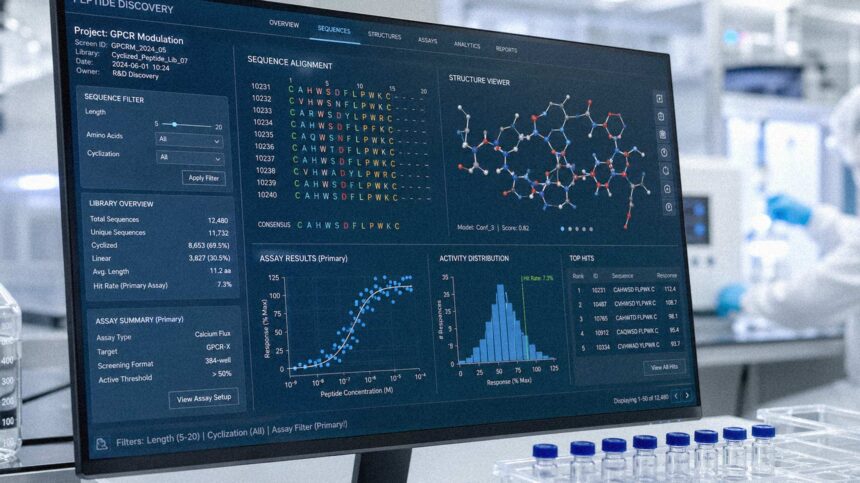
Artificial intelligence is becoming an increasingly important part of peptide research. In July 2026, researchers reported PeptiVerse, a unified computational platform designed to predict multiple properties of peptide molecules from sequence and chemical representations. The platform combines large foundation models with peptide and chemical data to support systematic research and molecular characterization.
A More Data-Driven Approach
Traditional peptide research often requires researchers to investigate molecular properties through a combination of laboratory experiments and analytical techniques. Computational tools can complement this work by helping researchers analyze large datasets and identify patterns that may deserve further experimental investigation.
PeptiVerse is designed to evaluate multiple peptide properties rather than focusing only on molecular binding. The researchers describe it as supporting both conventional amino-acid sequences and chemically modified peptide representations.
New Research Into Peptide–Receptor Interactions
Another active area is the discovery of peptide ligands for G-protein-coupled receptors (GPCRs). A July 2026 review in Nature Reviews Methods Primers describes advances involving combinatorial peptide libraries, computational design, structural analysis, and experimental screening.
These approaches give researchers additional ways to investigate how peptide molecules interact with biological receptors and how molecular structure influences those interactions.
Advances in Peptide Chemistry
Recent research is also exploring new methods for producing and modifying peptides. Nature currently highlights research into peptide cyclization, water-based peptide synthesis, peptide ligation, and other chemical approaches.
For example, researchers recently reported a method for peptide hydrazide ligation in a neutral aqueous environment, potentially simplifying certain laboratory synthesis workflows.
Why This Matters
The combination of AI, computational modelling, advanced chemistry, and experimental science is making peptide research increasingly interdisciplinary.
However, computational predictions and laboratory discoveries should be interpreted carefully. A predicted property or experimental observation does not automatically establish clinical safety or effectiveness. Those conclusions require appropriate scientific and, where applicable, clinical evidence.
As these technologies continue developing, researchers will have more sophisticated tools for studying peptide structure, molecular interactions, and biological functions.
This article is for educational and scientific information only and is not medical advice.